
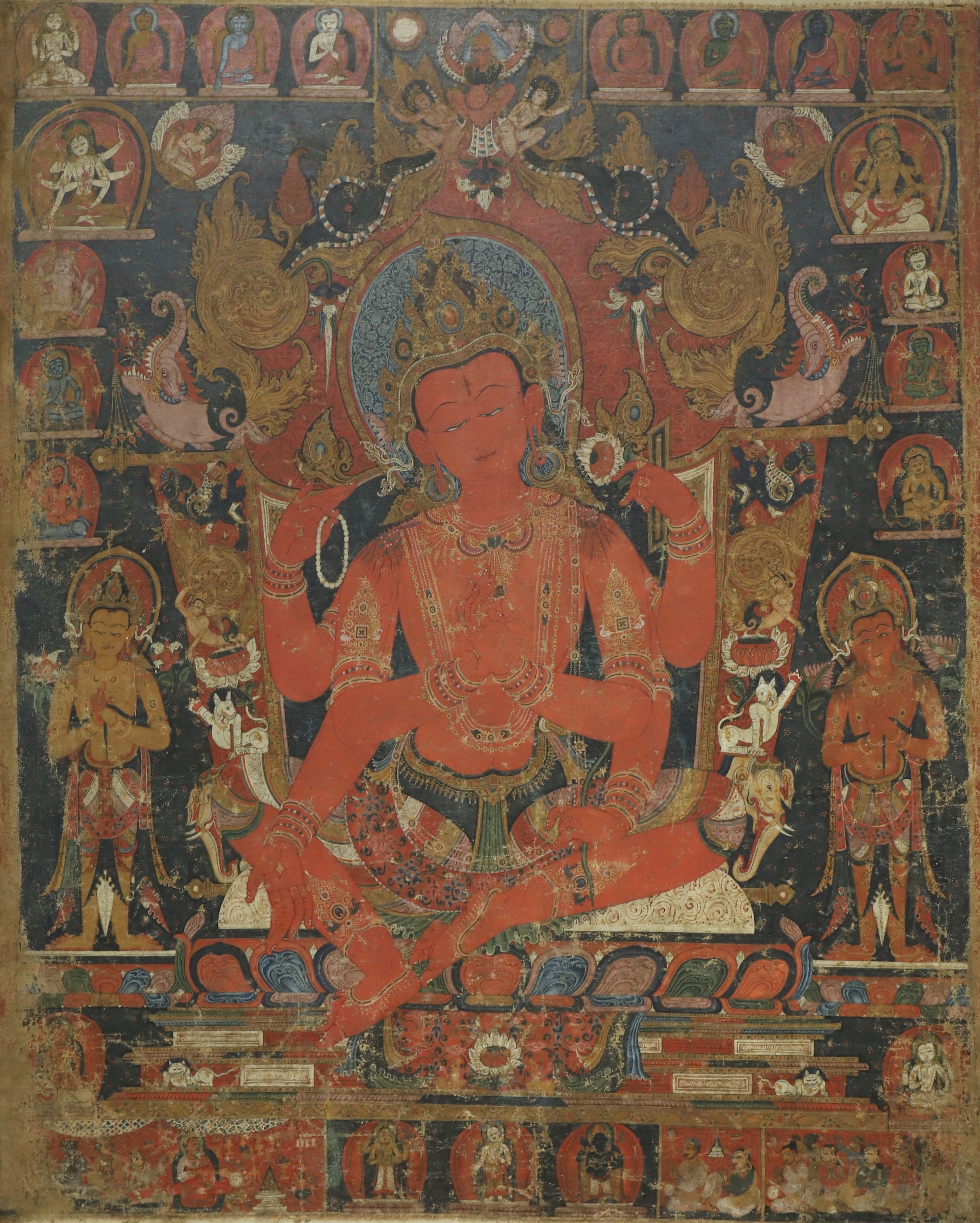
Pal P., Himalayas: An Aesthetic Adventure, Chicago: The Art Institute of Chicago, 2003, p.63
This painting is a fine example of a style that flourished both in the Kathmandu Valley and in the Sakya tradition of Tibet from about 1250 to the early fifteenth century. Apart from an illuminated manuscript from Nepal dated 1247, most early works in this style appear to have been made for Sakyapa patrons. The latest dated work in this style is the 1403 Vasudhara painting in the Zimmerman Collection. The Henss painting is certainly earlier, probably executed around the mid-fourteenth century. The delicacy and finesse of the ornamental details, the firm, confident draftsmanship, and the penchant for elaborate thrones are some of the major characteristics of this style. The rich variety of symbolic motifs of the throne – real and mythical animals and highly energised, intricate scrolling – are organised into a coherent visual design that enhances the vitality of the composition.The monumental central figure bedecked profusely in delicate jewelry represents an esoteric form of the bodhisattva Avalokiteshvara. With his uppermost hands, the red-complected bodhisattva holds a rosary and a book; the second pair displays the gesture of charity and a white lotus, his distinctive attribute; and the third pair forms the dharmachakra, the gesture of "dharma instructions", or turning the Wheel of Law, against his chest. Except for one attribute – a pot instead of a lotus – the form agrees with that known as Sukhavati Lokeshvara, as seen in the Machhender bahal in Kathmandu. In this paubha two bodhisattvas stand like sentinels on either side of Avalokiteshvara with splayed feet, while above and below are the eight regents of the eight directions. Two goddesses, a white Tara and the yellow Vasudhara, are larger figures in the upper corners of the blue field speckled with flowers, with the sun and moon symbols flanking the Garuda finial at the top of the throne. Five directional Buddhas led by Shakyamuni are sandwiched in the upper register between two forms of Shadakshari Lokeshvara. In the bottom register three female deities – Prajnaparamita, Tara, and possibly Bhrikuti –stand in the center with panels depicting the priestly consecration of the paubha on the left and the donors on the right.

